Wednesday, 6 February 2013

Elsie Cat (Khanate Miss Moneypenny) - Tribute to a Lost Friend

[The post below was written several months ago when the pain was raw. I felt that I needed to announce Elsie's loss to those who are close to me, who knew that Elsie was a dear friend.  I always meant to add it here as a tribute to her, and as it may perhaps be of interest to others who have lost feline family (although I know many will find it silly). Then I got too busy and it seemed too personal, but I have decided to add it now. I still miss my lovely furry girl.]

It is with absolute devastation that I must announce the loss of my most precious darling Persian Elsie, who died a few weeks ago after a far too rapid downturn owing to kidney disease.
I wanted to write these words the second that she left, but apart from feeling rather traumatised, I had to focus on pretending to be fine because Elsie died on my second day in a new, much needed job after I had been out of work for months.  But even belatedly, I must pay tribute to my sweet little girl and hope that it will give a feel for her dear magnificence. She was so warm and loving, so much fun every minute, it was a comfort just knowing she was in the world. She made me smile at the darkest of times, and my heart leapt a bit as I walked home knowing that soon I’d be enjoying that bewitching disposition again.

Elsie brought a new sunshine into my life in October 2008. Some months after the dreadful loss of my 19-year-old dear Darryl, my mother sent me details of two Persians. They were no longer available when I contacted the Rushden Persian Rescue Centre, but two other cats needing one home had arrived that day. They were put on reserve for me and when I later saw the photo of a blurry Alfie and gorgeous blue and white Elsie, I was firmly hooked, but an email going astray meant I nearly lost them. Happily, things were saved in time so I drove the 100 miles to reach them.
The eight-year-olds looked like kittens and had recently been shaved because their last owners hadn’t maintained their coats. They’d been raised on the cat equivalent of Fruit Loops, so had many of their teeth removed at the Centre (and most of the rest soon afterwards). As I filled out the adoption paperwork, Elsie jumped up on the table and affectionately rubbed my arm, so the people at the Centre said she was a lucky girl, but I knew I was the lucky one. 
On the long drive home, Elsie and Alfie each meowed incessantly to a different beat, with Elsie adorably sticking her giant white mitts through the bars of the carrier, which I learned was a crucial art of travelling for her. She panicked the one time I put her in a carrier with a door without paw access. Whenever we journeyed to the vets, she would calm as I patted her, stick her furry white mitts through the grill and watch with fascination all that the cab passed.

When I first brought Alfie and Elsie home, I expected them to hide for days and make a mess as potentially frightened, disoriented rescue cats can.  But Elsie came straight out of her carrier, used the new scratching post, and calmly stretched out on the bed, purring as though she’d lived there for years. I look at the pictures I took then and long for that day that was all about hope and beginnings, not the tragic end.
From that first night until the last month of her life, Elsie slept on top of me. That made waking such fun, although once she’d built up her strength, it meant I was pinned down by a relentless great weight.  Sadly later in life, she weighed almost nothing and struggled to keep her balance on the mound of me. But she’d immediately become indispensable. She was my little lapdog, without sitting on my lap. She would stretch out beside me, usually on the back of the sofa after kneading it whilst purring. She’d lie at my shoulder for hours as though she were my parrot and I was a lucky pirate.
Elsie quickly taught me how she loved to be tickled under her ‘arms’, manoeuvring my hand in place and slinging a back leg over my wrist to hold it there gently, as though I wore a furry mitten. She’d purr blissfully, as she did when pointing her chin skywards whenever I rubbed it. She treasured most contact and relished head massages, which I did when she was at the vets recently and in her last hour when little else made her comfortable.

Quickly after she came to me, Elsie’s coat became double-thick, which made her a stunningly gorgeous fluffball but was painful for her when tackled with a brush. Dear Elsie was so patiently angelic, sitting without complaint, that I had to watch the clock to ensure I didn’t torment her for long, whereas I could never wait to release the struggling, scratching Alfie. Often the vet remarked on how perfectly behaved she was, suggesting she wouldn’t need to be sedated for a procedure that required the cat to remain still.

It soon became obvious to me that, although their past owners had asked that Alfie and Elsie remain together, Elsie might have voted differently had she been consulted.  Although she initially seemed twice Alfie’s size and was some months older, he had established himself as a brutal Alpha-(Alfie)-cat, who imagined he was a lion cub and Elsie was his own personal gazelle. I’d sometimes rush to the sound of a struggle and find Elsie pinned down, Alfie’s claws and teeth ruthlessly preventing her escape like a tiger in a Rousseau painting.  He valued her company when he needed a pillow or felt chilly, and she showed remarkable patience, only looking irked when he pushed her off her chair. If I weren’t nearby playing lunchroom monitor, he’d push her away from her food as well. Elsie generally accepted her lot, bless her, but I helped when I could. 
She was fascinated by running water, watching the washing machine and seeing the bathroom as an adventure. After witnessing her often precariously balance on the edge of the tub and stretch into the sink to reach running water, I bought her a cat drinking fountain, which she used all the time. Her apparently supersonic hearing meant that, even if she were asleep in a distant room when I momentarily turned off the fountain to use that socket, she’d be there in seconds, looking up at me with an irresistible, urging face. She was often waiting for me as I showered, keen to watch the water drain, sometimes leaping into the tub once I’d left it, but fortunately never into a pool of water.  I still find myself arranging the shower curtain to make it easier for Elsie to jump in, ‘til I remember. 

So she brightened many of my dull routines. One of her favourite places was atop a little drawer tower by where I put on my face each morning. She’d be curled up cutely at my eye-level, often with her foot dangling in the top drawer, gazing out the window to watch the world go by on the lane opposite the garden.  I would pass through there not long afterwards, and I’d always look up to where I knew she was watching although I couldn’t see her through the net curtains.  It warmed my heart and sent me happily on my way, imagining that I met her gorgeous gaze, feeling her calming presence.  As it’s a habit of many years, I still look up hopefully at that window as I pass, but then remember there’s no one there, and it leaves me sunken and hollow.
Elsie even made using the fridge fun. She adored peering into this mysterious alien world, experiencing the new smells and cool feeling, so I got into the habit of holding the door open a bit longer. Similarly, making the bed became a game with Elsie and Alfie ‘helping’ by hiding under the covers and climbing onto each new layer, pouncing playfully on my hand beneath it.  Elsie also loved boxes, and as soon as I opened a delivery, I’d hear a gentle thud and find an adorable little deliriously happy face peering out from the packaging. Elsie’s enchanted interest brightened everything. Now I hold open the fridge door, then realise there’s no point, and unpack boxes with little zeal. Everything’s dull once again. 

Wonderfully calm as she was by default, Elsie turned delightfully, feistily wild when it was playtime, adorably amusing in her madness when a game was on. Her preference was for balls, which she would dribble down the hall between all four feet like a professional footballer with two advantages.  She particularly loved a ball-shaped mouse, which she would catch on her claw, fling across the room in a lacrosse move, then run to chase it.  Her eyes would even light up expectantly as I flossed my teeth, looking deflated when I threw away the floss until I got a new piece and played with her.  She loved--and I quickly learned the hard way that she would swallow--anything ribbon-like, so I had to be careful that nothing remotely like string (even paper from a straw) was left out, as on more than one occasion, we did a magician’s trick where I pulled what seemed to be an endless length of ribbon from her mouth (and, I fear, beyond).
She would often Tigger-bounce with glee and attack a toy suddenly, then rush away. She adored two ball-in-track toys, one she preferred to tackle whilst upside down, and a circular one that she would literally leap for joy towards when she saw it. She’d stretch each of her front legs into either side of the tubular track and bat the ball between her paws with great vigour.  If she’d stood up suddenly, she’d surely be entangled in the toy, so it was only used under supervision. That favourite toy that brought such excitement now lies joyless and still.
Elsie walked like a casually stalking tiger then would suddenly gallop away like a polo pony. She had an expressive tail like a fuzzy elephant’s trunk with a life of its own.  While the rest of her lay still, her tapping ‘trunk’ would often reach out and curl affectionately around my neck like a mother elephant calming her calf, or a friend’s gentle arm. She adored balancing on top of chairs, but in her last fortnight, she was so frail, she nearly toppled off, so I bought some pillows to pack high behind the chair to protect her. Sadly, she faded so quickly that she never climbed that chair again, and seeing the pillows she never used makes my heart sink.
I’m similarly gutted that I don’t have a recording of her beautifully sweet voice. When she first arrived, I’d sometimes hear what sounded like an urgent call and would rush to answer, only to find her sitting innocently wondering why I was rushing around.  She spoke rarely but with a sweet, warm trilling, a high-pitched yet smoky “Brrrr-ow?” Unlike a Lassie-style urgent demand, it was more of a delicate request à la, “I’m so sorry to trouble you, but would you mind awfully changing the filter in the drinking fountain, if it’s no bother?”’  

Apart from a wee bit of clawing on a chair and suitcase—which she would instantly stop with a look of surprise when I gently admonished her--her only slight naughtiness was something she didn’t understand to be bad, as it was purely a safety concern. She adored out of the way hidey-holes, such as sleeping behind the telly amidst a worrying tangled web of wires on a socket.  She’d occasionally crawl on top of the sideboard, turning brightly to me to share the delight of this activity as she accidentally knocked over silver candlesticks and picture frames with every step.

The rare times she wasn’t on me when I woke, I could feel her furry self slotted in the low narrow gap between the bed and bedside chair. On the morning of a job interview, I became nearly hysterical when I couldn’t find her in any of these places, and eventually learned that her cloak of invisibility was in fact a tiny spot under a precarious pile of heavy things including an old printer/scanner in the spare room. Once, when my plumber popped out for tools after removing the cover of my fired-up boiler, I raced to the kitchen to find dear Elsie heading for this newly revealed space despite the exposed flame. She was never stupid, but I always worried that the old adage about curiosity and cats might apply to her one day.
Happily, not every joy spot was dangerous. She preferred to sit on paper, stacks of magazines or gift wrap left out for her, as well as canvas or crinkly plastic.  I was often pleasantly foiled when I couldn’t see my work as Elsie draped herself across it. Not long ago, she started sleeping on my camera bags on a wheeled desk chair, which required impressive balancing, and on a garment bag that I’d left on the bed as it inspired such amusement. I could never keep the cover on my printer, which she would paw at until she pulled it on the floor, where she would arrange a little Elsie nest, enraptured for ages.  I can finally return the cover to my printer, but can’t bear to. It remains on the floor with an indentation in the shape of a little curled up Else.
Near the end when she was feeling rough, Elsie retreated to a hidden spot on top of some tucked away shopping bags. I added a soft blanket and orthopaedic pad to make her comfortable, but she moved them aside in favour of her beloved bags, so I covered her with the blanket at night, like tucking an adored child into bed. 
A beautiful, gentle soul she was, here was a cat that was sweetness all day long.  She yawned as though she were laughing and was a captivating whiskery sleeper who tucked one cheek under to become an abstract ball of fluffy loveliness. She held no grudges despite my regularly brushing her and doling out tablets, which involved picking her up, which she hated. I’d warn her with a sinking, apologetic “I’m sor-ry” in a Scooby Doo voice, and she understood with golden patience. She always wore a smiling, wizened look that exuded calm, and I’d brush my face against her gorgeous fur while with a sniff, she checked what I’d been eating, politely never grimacing.
She’d always rush cheerfully to me when I called, and her darling, affectionate behaviour meant she was near me most of the time. She slept on me, sat by me, watched me brush my teeth, kept me company in the kitchen, greeted me at the top of the stairs, ‘helped’ me put on my face each day, and brought me constant joy. So you mustn’t think that because I was only able to share some years of her life, that lessens my pain. We instantly took to each other with a mutual adoration, and I am haunted by her absence at every step as she was always by my side.  I often rehearsed a mantra in my head to remind me of my blessings in her and Alfie no matter what grief I faced, and when I catch myself thinking it now, it’s painful. I look for her when I come home, when I get out of the shower, when I wake, but she’s no longer waiting for me.  I see her ghost everywhere in the outline of the void.

I do have a picture of Elsie as a kitten, which my mother found on her breeders’ website, where they explained how they socialised their kittens, which worked wonders. She was a precious princess without airs and a joy to spend time with. I gladly indulged her odd hobbies, like her love for licking textures, from a rough cardboard scratching ramp to the wall inside the porch where paint had peeled away. Our visits to the porch turned her into a breeze darting past my legs with child-in-Disneyworld excitement.  I would sometimes leave her to her elation and loved hearing her push open and shut the toddler gate on the stairs when she was ready to return.
Elsie was gorgeous from every angle, with those darling big mitts and a splendid white ‘tache that I could see emerging from the darkness. Most pictures don’t do her justice because she was wary of the camera, but she seemed gloriously designed by a star architect and perfectly painted.  A breathtaking beauty and always a lady, she rarely failed to cross her (front) legs.  Looking at her photographs warms me as I’m reminded of her eternal cheerfulness and her affectionate gaze that really looked into my eyes, and I become immersed in the awesome experience of Elsie. She was beautiful inside and out, always brightly welcoming and would move toward my outstretched hand for a pat, gently purring.
Elsie in the past year developed a horrible cough, first thought to be asthma, for which she took steroids. She coped beautifully, but her weight loss revealed kidney disease rearing its dreaded head.  As she still raced around enjoying life, I remained hopeful that she would live for many years, but her test results regularly worsened. The vet was always astonished they belonged to this bright and cheerful cat. I considered myself lucky and valued the time with her, but that luck could not last.
As toxins built up in her body, she felt sick and developed ulcers, but always angelically took all her tablets, just gently voicing protest when I picked her up. In the end, she refused only the treats that I gave her as a “spoonful of sugar”. I hated making her, even for a second, dread my coming near, but she never held grudges and always returned to her extraordinary exuberance.
When she lost interest in her food, I was thankful that being out of work meant I had time to follow and coax her with an enthusiastic “Eez yummy, Elsie Cat!”, to which she’d respond, often eating whilst balancing atop a living room chair. Her special dish now lies heartbreakingly empty and unused by the sink. 
I somehow mustn’t let the gnawing guilt and horror of the very end overshadow the astounding happiness of my time with her. But the night before I started my job, my dear Elsie was in the vets on an IV drip. I’d visited her after leaving her there that morning, and I had naively expected her to be revived as Darryl had been after IV fluids, forgetting that Elsie’s condition was part of a terminal illness and not dehydration. The next day, ringing from my new staff room surrounded by strangers, I used all my energy not to react as I heard the horrid news that there’d been no improvement and she still wouldn’t eat. I sobbed the whole way on the train to the vets,  refused to end things there and expected to leave her another night, but despite her being weak and tethered to an IV, she rolled lovingly in my lap to make it clear she wanted to come home, so she did. 
Elsie felt too ill to leave her carrier, refused food and disliked having fluid syringed into her mouth.  I slept on the floor beside her and was desperate for her to make it to the weekend so I could spend time with her, but when I thought how long it had been since she’d eaten, I realised I couldn’t keep her going in what must be great discomfort just to suit my schedule. Dreadfully, I arranged for a vet home visit, and on my second day of work had to ask my new boss as soon as he arrived (painfully late) to let me leave, trying not to explain as I would sob uncontrollably.  I tragically barely had time with Elsie before my vet was due to arrive, but I massaged her head, explained what was going to happen, how I adored her and how happy she had made me. She suddenly lumbered into the bed by the carrier just before the vet came, collapsing where I could pat her more easily and take a last photo of my beautiful girl.
I’m thankful that being out of work for so long gave me so much blissful time with her.  Although nearly 12 was a respectable age, I had hoped for many more years together, and now struggle to suppress my agony. Thankfully Meowfie is a loud purr therapist who has been cuddling me as a poor substitute for his Elsie pillow. Earlier tonight, he was sitting on me as I found a video clip of Elsie cutely yawning out of a snooze on a stack of newspapers. Alfie bolted upright and was transfixed, leapt towards the screen, then realised it was a flat image and left.  I wonder what he makes of it all. It brought me some comfort seeing her, but I miss the reality of her, her presence, sweetness and purr. 
A couple mornings after she died, I put the blind up and realised I’d just caught sight of her face. Compelled to look again, I saw that in a puddle on the lane that she had often watched over was Elsie’s face looking up at me.  Unlike a fleeting image picked out of a cloud formation or an awkward constellation in the stars, her image was clear, with no other shapes or colours near it.  The cause was the marque of a car reflected upside down in the water, but it was Elsie’s face. I am not mad, but it brought me silly comfort that morning, which I needed.
What keeps me going is the residual joy of having had her in my life at all. Her stunningly beautiful personality seems to burst from every photograph, and immersing myself in her memories cheers me somewhat.  My gorgeous girl gave off a constant air of joy, grace, patience, fun and warm affection.  For years to come, whenever I travel with the suitcase that I left too long in the hall, I will smile fondly at the fringe down the edges, an Elsie Claw design.  In many ways, I feel I’ve lost my closest friend, who lit up my life every moment of the day, so I’m struggling with the blunt weight of the void. I’m tormented by the brutal memories of the last minutes of her life, and am utterly gutted to be without her. But I thank God for the time I did have with this enchanting gorgeous girl who changed my life for the better.  May she be bounding around somewhere heavenly now, free of debilitating disease, and loving an afterlife as she loved this one.  Bless you always, my beautiful, beautiful Elsie girl.


Monday, 9 April 2012

The Fabergé Big Egg Hunt

A few weeks ago, en route to an interview, I came across a giant egg sitting on a base outside the National Gallery.  I obviously couldn’t be late for my interview, but it would have killed me to run past without pausing to inspect it. So I took a quick photo of the first egg I saw in the Fabergé Big Egg Hunt before I was entirely aware of it.  Not long afterwards, that egg was sadly stolen. The egg in question was Our Team by Charlie’s Cartoons, covered in athletes and thus very 2012 with a nod to the Olympics.  Later, I noticed a green one nearby with a small clock in it, called Cuckoo, and my interest was piqued.
I remember the magic a few years ago of wandering around London photographing elephants, which is not something I would have expected to say or do.  The elephants in question were decorated by artists for the charity The Elephant Family  (which aims to turn around the fate of the Asian elephants, which face extinction after 90% have disappeared over the past century,  by creating crucial projects in their native countries and by raising awareness).  The Egg Hunt raises money for that charity and Action for Children, which supports around 50k of the UK’s most vulnerable and neglected young people. 

Basically, the Big Egg Hunt, presented by  Fabergé, had 210 differently and creatively decorated egg sculptures that were 2.5 feet high scattered in late February around London in 12 Egg Zones, such as The City, the South Bank and  the Docklands.  People were encouraged to hunt for them and tick them off a list in an attempt to break the Guinness World Record for the most people participating in an Egg Hunt.  The project aims to raise over £2 million for the above charities.  

Each egg sculpture had a coded number on its plinth, and egg hunters were encouraged to text that (each text being a £3 donation) to enter a contest to win a golden Fabergé Diamond Jubilee Egg valued at about £100,000.  Also, all eggs are being auctioned off.  Some have already been sold, but most auctions end at 6pm on Easter Monday.  They generally seem to be going for about £1500 each, with some more popular ones, such as Odele Kidd’s gorgeous Polar Bear Ballet, which I sadly never saw in person, going for £20,000.  The bidding for one egg that is yet to be painted—the Chapman Brothers will paint the winning bidder’s portrait as Humpty Dumpty on an egg—is at £25,000.  It’s great news for all the artists, for the people who get these fantastic sculptures, and for the charities. 
I stumbled upon several eggs a few days after seeing my first, when walking through the royal parks, and then made a point of walking around the deserted City on a Saturday to snap several neat eggs there, and was interested to see several other people doing the egg hunt, even in that deserted part of town.  I intended to go out to do other Zones later when I learned that those eggs had been moved to Covent Garden, for an Egg-stravaganza.  All the remaining eggs were lined up in different parts of the Piazza, hung from the ceilings or dotted around the Market Building, or hidden in store windows.  People dressed (sort of) in bunny outfits were collecting donations and selling Big Egg Hunt books for a donation of £2.50, which listed all the eggs and enabled people to tick them off when they found each one, and then get a certificate when they found them all.
Such things are so important—not just for the charitable cause, which is crucial, but for the delight that it brings to so many people. Part of being a Londoner is enjoying the unexpected, coming across surprising sights every day.  Or being able to go out looking for them when you know they are there. And the sheer number of parents with their kids who had clearly made it a day out to mark off all the eggs even when they were all together in Covent Garden was  proof enough of the joy the project brought to so many. 
There were furry ones, beautifully coloured ones, one made of pennies, one that reacted to warmth to retain people’s handprints, ones with animals, ones making a statement, one with Maggie Smith’s Downton Abbey character painted on it, ones with legs, mosaic ones, one that looks like the Gherkin (which wasn’t the one in front of the Gherkin), metal sculpted ones including a bird cage, a Mr Potato Head one, ones you could look into, and ones that deserved to be in the Tate or National Gallery.  There was also a Where’s Wally egg (Where’s Waldo to us Americans) that was moved regularly, so it was harder to spot.

I simply smile when the various eggs come up in the slideshow screensaver on my PC, giving me the chance to inspect and enjoy so many of them more than I had before.  And I’m so pleased that the bidding for them has been so successful. There’s still a tiny bit of time left if anyone wants one of these gorgeous or fascinating big eggs in their home or garden. It beats an old Athena print or a garden gnome!  In any case, I urge you to visit the site to view the many varied, incredible eggs, read a bit about what motivated each artist, and donate to the cause if you can.  You can even buy miniature versions of some of the eggs or other gifts at the Egg Shop in Covent Garden or Selfridges.
Thank you, Big Egg Hunt coordinators, sponsors and artists—plus those in London who allowed it to happen.  This has been wonderful.


Tuesday, 3 April 2012

Talking Zoffany Sheaths as A Helicopter Lands in Trafalgar Square

The worrying news this morning that the Air Ambulance had to attend an accident on the M26 reminded me that, the other day, my plans to walk across busy Trafalgar Square were diverted by a helicopter landing in my path.


After a nearby job interview, I was drawn into St James's Park, where there are vast clusters of daffodils and cherry trees laden with early blossom in this freakishly gorgeous sunny time. I sat on a bench enjoying the peace of the stunning birdsong, but was chided by pigeons and waterfowl for not thinking to bring them food, unlike all the tourists whose snaps of their trip to London will feature grey squirrels taking treats from their hands, apparently one of London’s star attractions. I’m happy for the animals, though I was not surprised to see a rat scurrying in the reeds near the water. (I tried to convince myself that it was a water vole, which I’ve been trying to catch a glimpse of at the London Wetlands Centre for yonks, but it wasn’t Ratty; it was a rat.)

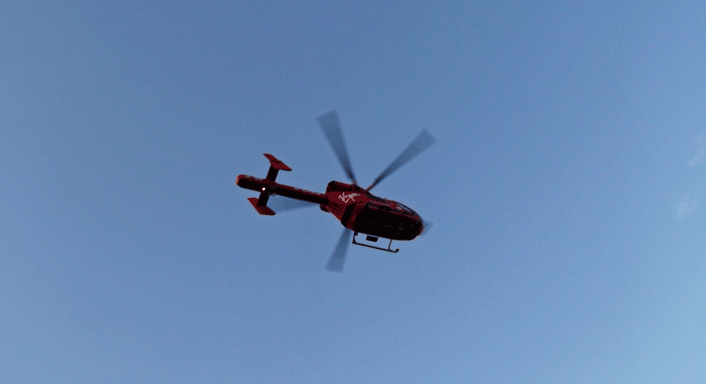
The chill moved me to decide to kill time until a lecture by viewing impressionist paintings in the National Gallery, which is fabulously free so you can dip in rather than exhausting yourself with the overwhelmingly large collection. I had just walked past the lions in Trafalgar Square and was about to manoeuvre my way through all the tourists when I heard a helicopter. This is such a frequent (and very noisy) occurrence in Central London now, I’ve almost stopped looking up, but this one caught my eye as it was bright red and hovering directly over the now empty Canada House on the west side of the Square. I was pretty sure that the only red helicopter was the London Air Ambulance and soon, like a normal ambulance, it sounded a siren—more of an alarm really, which I’ve never heard from a helicopter. It was rather surreal.

It seemed so inconceivable that something high in the sky should be sending a message down to us, like an alien spaceship indicating that it was coming in to land. Or maybe I’m alone in finding this surprising, the way seeing a lone plane in the dark sky with headlights lighting its way makes me smile, as though it needs to see where the road curves and avoid badgers and oncoming traffic.

So it took me and apparently the many others in the Square a few moments to twig that the helicopter was actually planning to land there, in Trafalgar Square, which was full of people, never mind the fountains, statues and the ginormous pointy thing that is Nelson’s Column. I’ve seen the Air Ambulance land in a road junction by my home in Greater London, but I’ve never heard of it landing in Trafalgar Square (though there’s no requirement to notify me). But when you think of it, if they needed to get an A&E doctor to a patient immediately in Central London, where else might they land? Nearby squares have trees, benches, statues and probably closer power lines.

Indeed, having sounded the warning alarm, the helicopter started descending toward us, and faced with the prospect of 3 tonnes of metal attached to a spinning chopping blade being lowered onto our heads, we had the sense to move. There were no single stupid people who you sometimes see lingering in such situations thinking it might be funny to be non-conformist, and we left plenty of room.

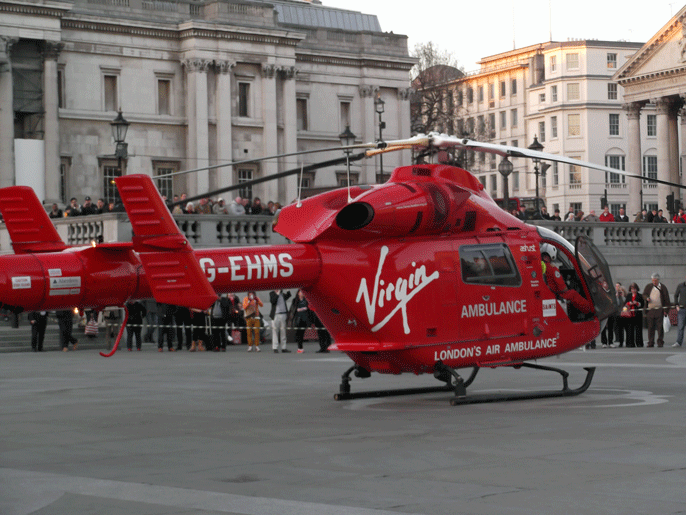
Many of us raised our cameras and phones to photo-graph the sight of a helicopter landing in front of us. I was aware that helicopters stirred up a lot of dust so I prepared to squint, but I was completely unprepared for the solid wall of filth that whacked us hard in the face and coated every strand of my hair. So we dropped our initially outstretched camera-holding arms, ducked and sought cover behind statues or construction sheeting nearby. When it seemed safe to look up again, there was indeed a bright red helicopter parked in front of us, on a little circle in the square that I never particularly noticed before. It is probably not coincidence that it was a perfect landing target for the helicopter—not that that made it easy; the skill of the pilots is amazing.

By the time I cleared enough grit out of my eyes to open them fully, the flying doctor and paramedic had already slipped out of the helicopter and out of sight. Several people wearing high visibility jackets marked “Heritage Advisor” appeared, people who I’ve never noticed but are presumably always in the Square advising tourists about heritage, with another duty being seeing to any sudden helicopter landings in the Square. They whipped out something like police tape and tried fairly unsuccessfully to tie it to fountains and any other anchor they could find.

They were perfectly genial people who didn’t need to move us back--we had all been cleared by the flying filth--but I suppose they were concerned about hundreds of tourists rushing to photograph each other smiling in front of the helicopter, getting in the way when it tried to take off, or climbing onto it whilst parked and dangling from its main rotor. (I say ‘main rotor’, but the MD902 Explorer twin engine helicopter has only one and no tail rotor, which is apparently better in an urban environment--less chance of chopping up people, perhaps.) This was a medical emergency, after all.

In fact, that was my primary thought—that it was awful that someone must be seriously hurt nearby. One of the Heritage Advisors trying to tie tape to us said there was an incident at Leicester Square, possibly in the Tube, which made me think the medics had disappeared so quickly because they were taken there by a London Ambulance vehicle or motorcycle, as that would otherwise be a fair run with all their heavy gear when they’d need to be fresh enough to save someone’s life on arrival (although I know they often do exactly that).

A fellow spectator on what I gather was a trendy bike with low wheels appeared beside me, saying he had assumed it was some sort of stunt since the helicopter had ‘Virgin’ emblazoned across it (and Richard Branson is rather stunt mad), but I explained that Virgin was a sponsor of the Air Ambulance, which is a charity. The charity operates London’s only Helicopter Emergency Medical Service (HEMS), which depends on public donations and which I gather is currently principally financed through Santander Corporate Banking with the support of Virgin. The service has been operating for 24 years, providing “pre-hospital care to victims of serious injury throughout London”, according to its website, carrying “a Senior Trauma Doctor and a specially trained Paramedic, essentially bringing the hospital to the patient. In serious cases the patient may not always be able survive the distance to hospital so operations need to be performed on scene.”

Based on top of the Royal London Hospital in Whitechapel, they have just moved to a new helipad on the refurbished building, now as high up as the Big Ben clock tower. The helicopter can reach anywhere within the M25 in 12 minutes, and since the service was founded, trauma deaths in London and on the M25 are said to have fallen by more than 50%. Since 6 March, the helicopter has even been carrying emergency blood supplies so transfusions can be administered at the scene of an accident.

I know about the Air Ambulance because I recall watching a BBC3 series some years ago called Trauma, where a camera crew followed the team to emergencies in the helicopter during the day and in the rapid response cars at night or when the helicopter was being repaired. It was gripping stuff. I watched the doctors anesthetise a patient and slice open his throat at a London road junction as police officers held a make-shift curtain around them to shield them from the gawping crowd, and perform roadside thoracotomies (open chest surgery) usually performed by a cardiothoracic surgeon in an operating theatre. Can you imagine the pressure on the lone HEMS doctor out on the road? Ably assisted by a remarkable paramedic, of course, but it’s not the same as a full medical team of specialists in a safe and sterilised environment.

I also watched the show as an injured motorcyclist began fighting off the people who were trying to save him, which I came to learn as a danger sign that the patient had suffered brain damage, which is when people retreat to such basic bestial behaviour. I watched, irritated with injured children in fairly inaccessible fields who refused to board the air ambulance that was their quickest and safest route to hospital, simply because they were frightened of flying. So they would have to travel by land ambulance, as the last thing the helicopter crew wanted in a confined space in the air was someone hysterical fighting them.

I also watched through my fingers as a very young but otherwise fanciable doctor comforted someone who had been initially unsuccessful in his suicide leap in front of a tube train and was frightfully injured but caught under the train so the HEMS doctor had to crawl under it as the fire service tried to lift it a bit so he could assess the patient and administer desperately needed pain relief. I seem to recall that he chatted to his patient while enormous numbers of emergency services workers spent ages either trying to free him or waiting to help him, but sadly the man died where he fell. Yet the doctor would have to get up from that and continue to respond to other calls that needed him.

Remembering that incident sent a chill down my spine as I noticed two men clad in red, looking like astronauts who had landed way off course as in that Specsavers advert, eventually return to the helicopter from the east side of the Square, watched by several motorcycle paramedics who presumably had brought them back from Leicester Square. They had no patient on a stretcher with them, and I worried that it had been an awful situation like that one I’d seen on Trauma. I said to the man beside me that perhaps the lack of patient meant he or she wasn’t as badly injured as originally thought, that they recovered or were fine to go in a normal ambulance, and I hoped more than believed that to be true. (The service tweeted afterwards to say that they don’t always carry a patient, that the Air Ambulance is just used to get the medical expertise to the patient quickly. I will focus on that being the case. You can follow them on Twitter here: @TheHelilpad .)
We watched as the pilot opened the boot of the helicopter and shoved in some gear, the same way we mere mortals do with a car. They donned their white crash helmets (would they help if the three-tonne hunk of metal dropped from the sky? Or is it to battle the rotor blades if their proximity were miscalculated?), and one stepped away from the helicopter to assess the situation as someone might guide a car driver who was parallel parking, saying “You’re clear on this side.” That seemed reasonable until I realised that he could hardly join them after they took off, leaping into the air and grabbing the landing skids like Superman or a Bond villain. He managed to join them just before lift off.
I warned the cyclist standing by me to protect himself, given the incredible shock of filth that the helicopter had dumped on us on its way down, but it seemed that that first episode had tidied up Trafalgar Square to such a degree that very little dirt was left to be dislodged by the rotor blades spinning this time. (I think most of it was in my hair). The rotor revved up quickly, and as soon as the helicopter began to lift off, it seemed to dart to a great height in an instant. “It’s like a Harrier Jump Jet,” I stupidly remarked to the Stranger Cyclist, and he agreed. And then it was off, the Heritage Advisors removed the tape that had pretty much blown away and they disappeared, and Trafalgar Square went back to normal. People passing just afterwards had no idea what they'd missed.


I was accustomed, thanks to the television series, to seeing the remarkable work of these medics, and here
was an example of the tremendous skill of the pilots, too. The service will apparently be featured in another television show in June called Real Rescue, presented by former BBC Breakfast sports presenter and Strictly Come Dancing winner Chris Hollins. Make sure you watch it, as if this show is even a patch on Trauma, we viewers will be lucky. I feel the programme did a lot to promote the incredible emergency services as well as the Royal London and A&E departments generally (as Helicopter Heroes also now promotes other air ambulance services). Another fly-on-the-wall programme featuring the London Air Ambulance called Medic One can still be seen on YouTube, and it’s worth having a look. And if you can, perhaps donate even a small something to this amazing service that saves lives daily.

It had been interesting watching everyone’s reaction to the sudden appearance of this bright red bird in a space previously ruled by pigeons, and there are many better photographs than mine on the Internet, as obviously many tourists and, judging by the kit they were carrying, some professional photographers moved around the Square to get the best angle. I only had a little camera I keep in my handbag that is marginally better than the appalling camera on my phone, and I stayed put and chatted to Stranger Cyclist, who reminded me of several cultured people I knew.

Perhaps I’d mentioned that I’d been heading for the National Gallery, which led to talk of the Royal Academy exhibitions, and I mentioned how I’d been lucky to see the superb David Hockney exhibition when a company kindly gave me a free pass after a job interview with them. He mused about whether it was some sort of assessment centre exercise, and whether they quizzed me on my favourite paintings afterwards. They didn’t, but it did start me wondering about whether the pass had some GPS monitor so they could note down which paintings I spent more time in front of, and then judge me in the same way they might evaluate my handwriting or the answers to a ridiculous psychometric test (I used to like those, but the last one I took—given by my former employer—had questions such as “Chose which of the following best describes you: (a) you have red hair, (b) your favourite colour is red, or (c) you always see red.” So I had little faith in its ultimate judgement.)

Stranger Cyclist asked if I’d seen the RA’s Johan Zoffany exhibit, which I haven’t, but which was recommended by a friend who, like Stranger Cyclist, had recently retired. Stranger Cyclist (which I accidentally just typed as ‘’Strangler Cyclist” but he seemed safe) described to me The Tribuna of the Uffizi , which amazingly includes a reproduction of over a dozen works at the Uffizi museum in Florence, which I feel I’ve seen—perhaps at Windsor? (It took me years to learn there is a breath-taking collection of works by all the greats at Windsor Castle.)

Stranger Cyclist also referred to a self-portrait in the exhibition that showed some condoms hanging in the background as Zoffany prepared for a fancy dress ball. (I note that the Times Literary Supplement classics editor, Mary Beard, as a result of seeing this painting posed the question “How many condoms did Zoffany paint?”  Who would have thought the controversy now was about quantity?)

I later mentioned in an email to my newly retired friend that the exhibition had also been recommended by another person who had seemed to be a sensible intellectual type, despite being a stranger I’d met in Trafalgar Square who mentioned condoms. Said friend made me laugh when he replied that he was “relieved to hear that at last you are talking to strange men in Trafalgar Square about condoms. You really should have done this earlier.”

I only do so on occasions when bright red helicopters land at my feet in famous London landmarks. And then, always. Until next time….