 I am not a gardener and never will be. I find no pleasure in the thought of filthy
fingernails and insurmountable amounts of patience waiting for the fruition of
hard work that is then consumed by insects.
When I was younger, I rarely noticed flowers and greenery, perhaps taking
them for granted as I grew up in a very green state (I mean I lived in one of
the verdant United States of America; I don’t mean that I was particularly
envious).
But these days, I find enormous solace by sitting in a city square at lunchtime, or in a park watching water birds seem to dissipate the pollution and stress. I get livid when I hear of plans to build on Green Belt land or to plough railway lines through Sites of Specific Scientific interest, destroying habitats. I am definitely a City Mouse, but there is enormous pleasure—and health—to be found outdoors spending time with nature and one’s thoughts, absorbing the calm, particularly when the jungle that surrounds you is concrete and the few gardens near you have been paved for parking.
 So the old me paid little attention to the annual Open
Garden Squares weekend each June when over 200 urban oases are open to the
public, and I was surprised to learn that it had been running for 17 years by
2014. Then at last emails to us regular attenders
of the annual architectural splendour of the Open House weekend, with a small discount
on the £10 ticket, tempted me to give it a try, particularly as a private Pimlico
square I’ve longed to peer into was planning to throw open its gates.
Unlike Open House, you don’t have to book for gardens apart
from a few exceptions such as 10 Downing Street. But as I left it late to book and didn’t have
a chance to go through the glorious guide book until the Saturday it started, I
didn’t take full advantage of the weekend, but I still was surprisingly moved by
the few gardens I did get a chance to visit.
 And there are gardens of all types in all areas. Medicinal
gardens, wildlife gardens, skip gardens, private residential squares, kitchen
gardens, nurseries, gardens in hospices, museums, vicarages, and Buddhist
centres, tiny havens outside chocolate shops, allotments and garden farms, roof
gardens on tall city buildings, those in venues such as the Royal Hospital
Chelsea, 10 Downing Street and the Olympic Park. Not all gardens are open both
days, but the website and guidebook make that clear.
 The website has the same and a highly functional garden
selector, where you can specify the time and day when you want to visit, say,
wildlife gardens in Kensington that are not normally open to the public, or
rooftop gardens on a City skyscraper with a beekeeping demonstration. There is also a Smartphone app, and it
helpfully gives information on other gardens open in the area at the same time,
so you don’t really need to plan for ages; you could just wander. Outer London is included as well, but I had
my eyes on one particular garden in Pimlico.
I had also decided to go to several other places that looked
amazing in the catalogue, but I ended up only being able to get out on the
Sunday, and train delays prevented me from reaching my intended first stop of Nomura
International roof gardens, which came to interest me once someone tweeted a
picture of an owlet there, so instead I headed straight for Victoria.
 I had long wanted to see inside the secret and stunning
Eccleston Square and thought I’d only have a chance to go inside was once I had
married a resident Earl or won the Euromillions lottery and bought a place on
the Square. Ever since I once walked
past in early Spring and was captivated by its magic based on the stunning flowers
beckoning through the iron railings beneath towering trees, I knew that right
around the corner from Victoria station, there was paradise—but only for
residents.
Then a welcome chance to peek inside unexpectedly came
through the BBC’s coverage of the Chelsea Flower Show 2014, when Jo Thompson, designer
of the Gold Medal winning ‘London Square’ garden, was given a key to the hidden
kingdom of Eccleston Square, and her expert appreciation of some things I might
not have noticed in my ogling ignorance created more to love, but again from
afar. She praised the climbing rose on a tree that she had not expected to see
there, and the irises, gardenia and rhododendron, which would have reminded me
of home, as well as the ‘instant architecture’ of three silver birches planted
together. She then gave us a near aerial view from a top floor balcony on
Eccleston Square, and aptly said that the garden squares ‘give a sense that
they’re enabling the city to  breathe’, which I support.
 breathe’, which I support.
I thought that would be my only ‘visit’, until the wonderful
Open Garden Squares Weekend. Finally, I
was able to see inside Eccleston Square myself.
When I first entered, I came upon a table where two women who seemed
like they might be residents were seated, one chatting to someone about the
garden, and the other ‘looking on’, as poor caption writers always say. As neither seemed interested in checking the ticket
in my extended hand, I moved towards the man beside them who may have been the
head gardener, when the second woman snapped at me snootily to demand whether I
had a ticket as if I was daring to sneak in and steal the beauty.

Happily, that was the only variation all day from encounters
with nothing but delightful people thrilled to be sharing the experience. And immediately before me, paradise opened,
and thoughts of that woman’s unduly sharp demeanour faded away. The square was even more impressive than I
imagined from the crumbs I’d seen scattered around the outside. To my right and left were shady paths with
occasional pergolas covered with climbing roses, and straight ahead was glorious
planting opening into the main garden, which revealed a sizeable lawn area to
the right and tennis courts to the left.
As people behind me went elsewhere, I ventured right so I could have the
path all to myself, something I hadn’t expected but frequently enjoyed; I had wrongly
assumed the crowds might make enjoying the gardens difficult.
Happily, with so many gardens to see over two days and
several boroughs without set times and bookings required, that left plenty of
room for us to spread out. There was no
rush either; we could stand for an age in front of a particular flower garden,
or plonk ourselves down on one of the many lovely wooden benches and just sit
and read a book, as some people did, as though this was our own private
paradise.
 Eccleston Square was the masterpiece I expected, but
larger. It was a masterly joy of
hedgerows, gorgeous planting combinations, tall twisting trees, unpolished
benches looking like they’d been carved after a tree blew down, and amazing
scents that made it difficult to believe it was bordered by a busy London road
near Victoria station. We were even left free to peek into the marvellous greenhouse.
On the edges of the garden were long, beautifully isolated hidden paths that
let you imagine you were meandering through some country wood, luring you to duck under low branches
just for the chance to wander off somewhere.
 I won’t describe the beauty with purple prose, nor can I wow
you with the scientific names—or even the common names--of the plants I admired.
There were discreet markers to identify many of them, sometimes indicating that I was looking at a
‘rare bird’, and I was frequently impressed by unusual, racy looking floral
creatures. But
the language of flowers is Greek to me, even when labelled, so I will just have
to share a few of my photographs and hope you can get even a fraction of the
sense of beauty and calm that these gardens gave.
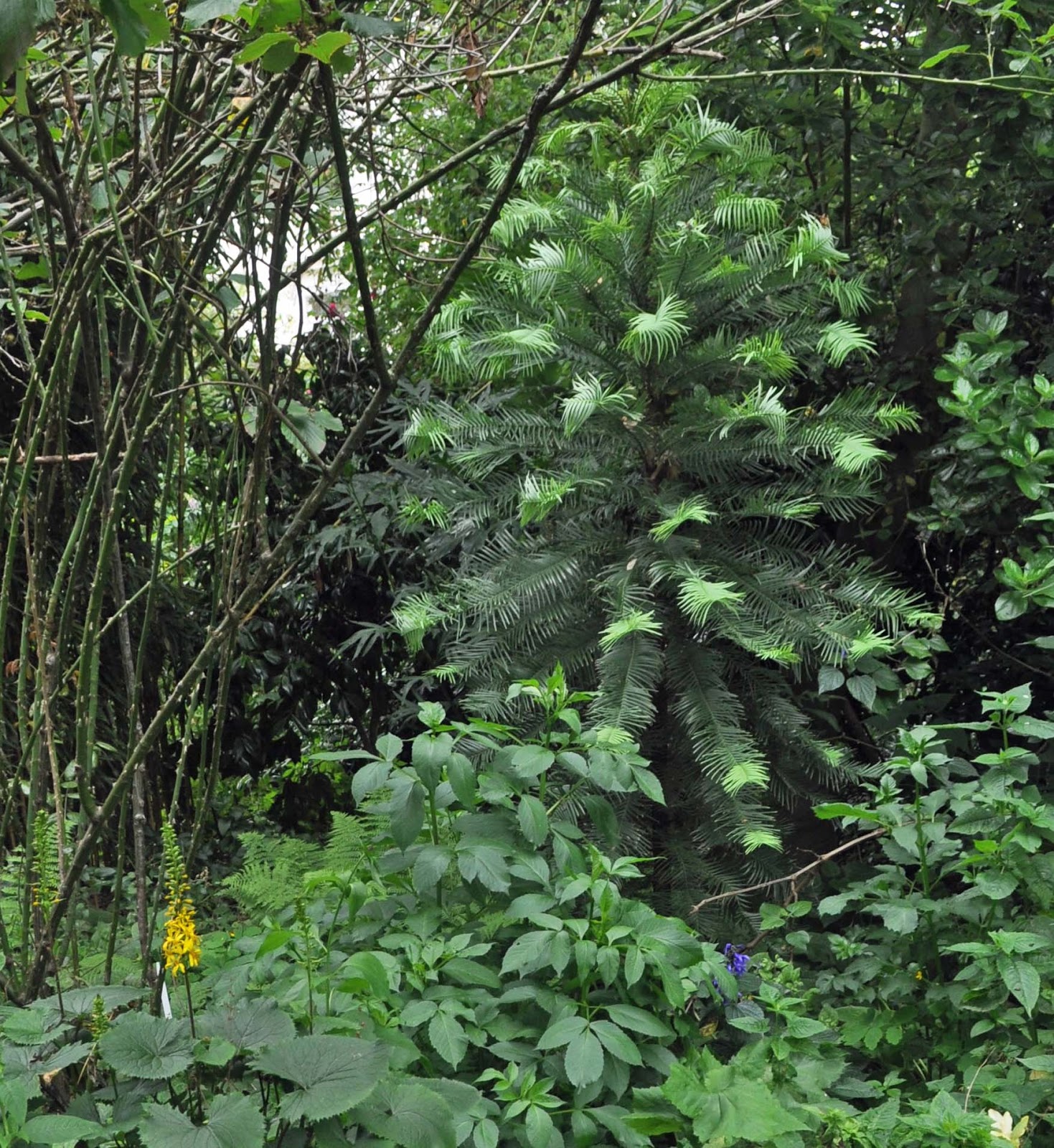 More than once on the Sunday, I would be thinking ‘what
pretty blue against that spiky thing’ and people behind me would come up and
murmer to each other, their faces deep in concentration, Greek things like, ‘Is
that a Queen Anne?’ and ‘I doubt it; they only grow in China and have three
petals, not four,’ or marvel that the shaggy looking green thing was a rare
Wollemi pine. People would think to brush
aside glamorous puffy flowers to reveal a tiny little blue treasure in the
undergrowth and say ‘You see the Latinus Floralbus?’--or some such name—“you
see how it doesn’t need any sunlight to grow? They’ve done it marvellously;
mine have always died.”
But my ignorant marvelling at the bigger picture did not
lessen the glory of the gardens for me. The beauty of them is that they
are—well, beautiful—to the uninformed observing eye as well as the all-seeing
eye, to the layman and the expert. Everything
was there to behold—pure splendour, even on this deeply cloudy day, although we
were lucky not to get the expected rain (though the gardens may disagree).

The gardens I visited weren’t all stuffy fragile things of
beauty with ‘please keep off the grass’ signs simply meant to be observed. They
had benches along their hidden paths, well-used tennis courts that were often
shielded by climbing roses and the like, as well as playgrounds for children
and even, in one case, a barbecue area. They
are living, functioning gardens, as well as places of respite and calm. Some contained miniature sections of wooded
forest, stunning floral beds far more creative than the average council green
with a few marigolds in an orderly pattern, some manicured lawn, winding paths
that beckon you irresistibly, some tropical looking areas and the gorgeous
backdrop of stunning terraces. They could be wonderful microcosms of the world,
the gardeners and garden designers having achieved masterly accomplishments in
small areas. Whatever the residents pay for the upkeep, it’s worth it.

When I tore myself away, I moved just a block away to Warwick Square, thinking the garden, as
another part of Thomas Cubitt’s Pimlico plan in the 1800s, would be similar but
unable to top the realised joy of Eccleston Square. However, it immediately impressed as visitors
entered through a tunnel of glorious greenery, through which we could see a
statue surrounded by stunning roses and lovely tall purple and white daisy-like
things (sorry to wow you with science).
Bird song collaborated with church bells emanating from the picturesque steeple
looming over one end of the garden. A resident
was telling someone as I entered that they usually did something jointly with
the church for this event, but the new vicar hadn’t yet had a chance to get his
feet under the table.

I once again admired the multi-layered planting of
remarkable combinations and heights amidst so much established greenery. In the middle of the  designed wilderness was
a manicured lawn, with incredible trees towering over both sides and lovely
sights of stephanotis and magnificent tall bulbous things that look like potted
Daisies left bare by a game of he-loves-me, he-loves-me-not. Robins were flitting about and singing, so
much laughter echoed around the square, and people made the most of the well
placed benches. That’s an added joy; you
aren’t shepherded in and forced to look and leave, with anxious people hovering
over you ready to shout, ‘Don’t touch that!’.
Instead, you can stop and enjoy
the garden. People were stretched out in
some gardens on the lawns chatting with friends. I chose a quiet bench by the
church, hidden amidst more greenery overhead but with a clear view across the
length of the square, and watched as sparrow fledglings hopped around the path at
my feet. The scent of the surrounding flowers was nearly dizzying, and
everything was perfect.
 designed wilderness was
a manicured lawn, with incredible trees towering over both sides and lovely
sights of stephanotis and magnificent tall bulbous things that look like potted
Daisies left bare by a game of he-loves-me, he-loves-me-not. Robins were flitting about and singing, so
much laughter echoed around the square, and people made the most of the well
placed benches. That’s an added joy; you
aren’t shepherded in and forced to look and leave, with anxious people hovering
over you ready to shout, ‘Don’t touch that!’.
Instead, you can stop and enjoy
the garden. People were stretched out in
some gardens on the lawns chatting with friends. I chose a quiet bench by the
church, hidden amidst more greenery overhead but with a clear view across the
length of the square, and watched as sparrow fledglings hopped around the path at
my feet. The scent of the surrounding flowers was nearly dizzying, and
everything was perfect.
 As I wandered around, again I was ogling beds thinking
‘oooo, pretty’ as pairs of gardening women strolled past making comments like
‘Is that a St Anne’s?‘ ‘No, it couldn’t grow here. Too acidic’ and other Greek
things that made me smile.
 A marvellous iron gate on the opposite side (through another
tunnel topped by blue flowers) had ‘Rus in Urbe’ inscribed in the iron, or
‘country in the city’. How perfectly
stated. I gather the gates are replacements of the originals that were lost in World
War II, a worthy project. The iron gate through
which we entered said ‘Paradiso Volupatatis’, which I believe means Garden of
Eden, a pleasurable paradise. The garden
certainly provides for all with the different (predominantly green) terrains, occasional
hiding places, a playground and a tennis court shielded by lovely planting. This visual paradise amidst the splendid soundscape
of chirping birds, church bells, the gentle pop of tennis balls at play and
sprigs of laughter was certainly no disappointment after the glory of Eccleston
Square, and it was hard to tear myself away.
 But I did move on, and as I left the square, I found that St
Gabriel’s Church benefited a great deal from viewing it with the garden in the
foreground, as the foliage and flowers covered up a row of Boris bikes, busy ‘no
entry’ signs and the ugliness of modern reality.
After Warwick, it was nearly 4pm, so I had no hope of making
Kensington in time to enjoy the gardens I’d hoped to see there, so I moved
along to nearby Eaton Square, which
I hadn’t intended to visit. How
fortunate that I made it there.
 The gardens of Eaton Square were also originally laid out by
Thomas Cubitt in the 1820s, and like others in the area, it was replanted in
the 1950s after much disruption during the war.
(In fact, several people including the Lord Mayor of Westminster were
killed there in an air shelter that took a direct hit, and cannon shells were
found in the Plane tree limbs when they were pruned in the 1970s.)
 This was a welcoming family-style place, as though they
chose to embrace the day by throwing a party rather than issue notices warning
their residents to stay away if they wanted peace. I had just missed the Punch and Judy show (I
didn’t mind; I hate domestic violence) but I stopped for a while near the fat
palmetto trees to hear the steel brass band give the occasion an island flavour
with jolly interpretations of those old Caribbean classics La Bamba and Sway. The lively band was terrific fun, performing
beside a fountain wall with water tumbling down it that I imagine is rather
soothing on less
 I was handed a Tree Walk Guide as I entered, which I wanted
to give back to keep my hands free and because, whilst I love there to be trees,
I didn’t think I was so worried about knowing the individuals. But I was
quickly pleased that I kept hold of it, as they had placed big numbers on some trees
around the garden and that would have driven my curiosity mad. You could check
the corresponding number on the guide to find that, for instance, that tree
came from New Zealand in the 1980s, or this one’s a Chinese katsura that smells
of burnt sugar (ah-hah! I’ve been baffled by that scent in St James’s
Square), or it’s a Japanese dogwood with horizontal branches, or an original
Plane tree and a past head gardener’s favourite. The sheet also provided the
bit of historical information I mentioned above. How grand that scrupulous historical records
have been kept and that this beauty didn’t just happen with blowing seeds and
bees (not that I imagined it did).
After leaving the slightly ‘built up’ area by the tennis court
and passing the many seats for the  audience in front of the puppet theatre
where I saw the Punch and Judy hands out of character, I passed through a brief
little woodland area where there was a log pile, good for wildlife particularly
like bees. This, in fact, was the
garden’s ‘habitat hideaway’ to encourage wildlife; they even had a wormery. A little path led to a tucked away bench on
the side beside a sculpted half-sphere coffee table.
 audience in front of the puppet theatre
where I saw the Punch and Judy hands out of character, I passed through a brief
little woodland area where there was a log pile, good for wildlife particularly
like bees. This, in fact, was the
garden’s ‘habitat hideaway’ to encourage wildlife; they even had a wormery. A little path led to a tucked away bench on
the side beside a sculpted half-sphere coffee table.
 The polished table was an example of what was tremendously
special about this square: it was full of fascinating art. There were numerous captivating sculptures, often
highly reflective or patterned metal cut-out spheres, some with ‘bites’ taken
out of them and a disco ball hidden in the woodland. Tucked in the planting by
a path was a marvellous Anthony Gormley like copper figure holding a sundial that
turned out to be a Light Sorceress. A ‘moon
dial’ sphere loomed behind a bench. These treasures emerged from the garden as
though you had stumbled upon a secret stranger lurking intriguingly in the bush.
 In the middle of the square, near where people were lying on
the grass laughing with friends, was a green bronze that looked a bit like a
model of the Gherkin (30 St Mary Axe, not the pickle) from one angle, but seemed
to divide into three pieces as you walked around it (called Eveque after a Bishop’s mitre). Another bronze Gherkin-like one on the edge
in the planting was called Quill, inspired by Mediterranean pencil pines, with
a pointed base and top. I later learned
the sculptures and sundials were by artist David Harber http://www.davidharber.co.uk/sculpture.htm and they certainly added to the magic of the square.
This certainly more family-oriented garden jolted with joy in
the welcoming party atmosphere and came prepared for the big day, even
providing a bright blue port-a-loo that the eye, if not the camera, overlooked. The rest of the square cried out to be
photographed, not just the

The garden welcomed families of all types, as recently occupied
bird boxes abounded and more newly fledged robins surrounded us. I would normally seek the peace I found in
the previous two gardens, but was easily enamoured of this wonderful place. It
would have been a dreadful shame to miss it.
Around the square on lovely homes were blue plaques for
Neville Chamberlain, which could be seen from the garden, and Vivien
Leigh. Vivien Leigh’s former home looked
out on a part of the garden that was separated by a road from the main section,
and it was closed to us. How lovely for
the residents that there are separate squares to enjoy, and presumably some
offer more peace, particularly on this day.
 I then passed through Chester Square on the way back to
Victoria station, which looked lovely and had a spectacular tree in the middle but
had already closed. Chester Square also
has a church and blue plaques, as an astonishing number of celebrities and a
few important figures have lived there over the years. I passed a blue plaque for
Frankenstein author Mary Shelley, and
the square was in the news a few days later when it was announced that Margaret
Thatcher’s last home there was going to be sold for £35 million once the
developers refurbished it to include one of those ghastly multi-storey basements
that I hope are outlawed soon. Surely someone would pay a ridiculous price for
the house as it was just to enjoy the green treasure on their doorstep.
 It’s truly so generous of people to open these gardens to us
during this wonderful weekend. Why would they want the scruffy public traipsing
through all day and trampling their precious flowers, even bringing dogs? Obviously, we weren’t doing any trampling; instead
we were highly appreciative, respectful admirers who acknowledged the privilege
of being guests for a bit. But if it
were me, I would have worried. Instead,
most of us smiled at each other as we shared this special experience, although
the gardens I went to were rarely crowded. I was always able to have a nice
wander at my own pace, could usually find a bench on which to pause and absorb
the glory, and I rarely had to wait for people to clear the scene so I could
snap a photo to let me carry on enjoying the gardens for years.
Although I only managed to visit a few gardens that were in
the same area and a somewhat similar style, I was still blown away by them and
felt my tenner was completely worthwhile.
I just cursed myself for not making the most of it by planning better
and getting out throughout the weekend.
Frankly, for the low price, even if you don’t have time to
do much, you should at least just get to a few gardens, whatever you can fit
in. You could even take a book and find
a quiet bench and just sit for a while in a garden you would not otherwise be able
to enter.

I had big plans last year and only managed three gardens,
yet I’m still talking about them a year later.
I also thought it worth reading through the 100+ page booklet that is included
with the ticket after the event with a view to making a point of visiting some
of the parks I knew nothing of that are regularly open. It’s a marvellous event highlighting London’s
jewels. Chelsea Flower Show is nothing compared to this—that’s just pretend and
temporary. These are the real things.
 If you haven’t booked ahead of time, you can book online and
get an e-ticket and electronic version of the guidebook, and the website and
related apps really tell you everything you could possibly need. Otherwise, you can get a ticket at certain
participating gardens. (See list.), or at the
City Information Centre on the river side of St Paul’s Cathedral, and you will
be handed the marvellous hard copy of the guide book (or collect it by showing
your e-ticket).
You could say that the
more gardens you get in, the better value you’ve created, but I would have been
thrilled with just the first one I visited; the others were icing and a cherry
on top. It’s a treasure of an
opportunity you really shouldn’t miss.
The gods of weather seem to agree and are smiling on you this weekend.
There’s a complete list of gardens here and you can search
for ones in your area http://www.opensquares.org/list.php
Just go!


 Posts


