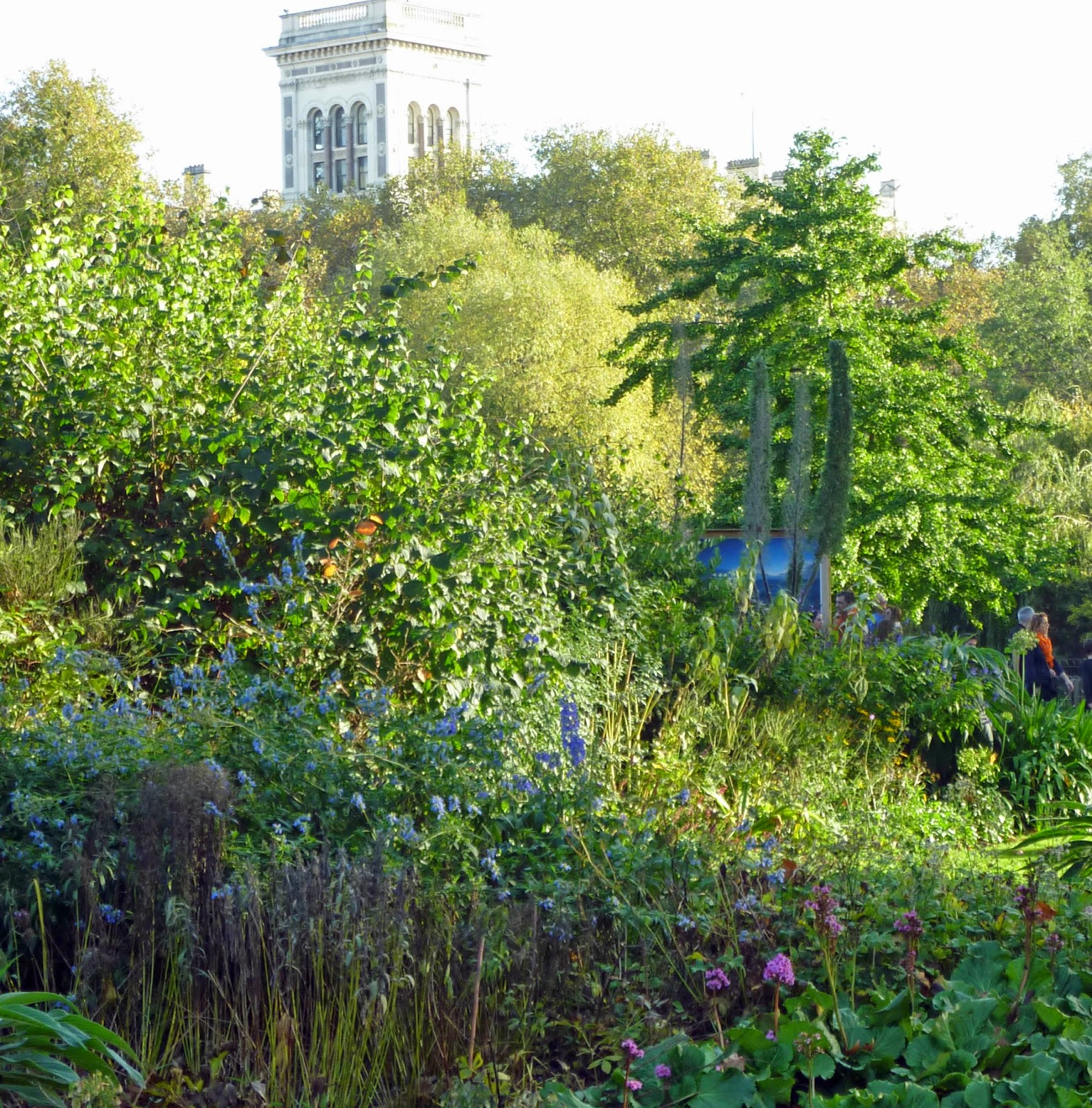
 On the warmest English Halloween on record, and the last
expected lovely day, I made certain I wandered out at lunchtime and into a
park, St James’s Park. As I admired the manicured
gardens along the path, I was curious to see a big square of midnight blue
amidst the greenery. As I neared, I saw
it was a painting. And behind it was
another, out in mid-air.
On the warmest English Halloween on record, and the last
expected lovely day, I made certain I wandered out at lunchtime and into a
park, St James’s Park. As I admired the manicured
gardens along the path, I was curious to see a big square of midnight blue
amidst the greenery. As I neared, I saw
it was a painting. And behind it was
another, out in mid-air. Surprisingly, there was a whole gallery outside in the Park
by the Guards Memorial across from Horse Guards Parade. One thing I love about London is stumbling
upon public art, particularly in unexpected places, and this was particularly
unexpected, as rather than a statue or painted Paddington Bear, it seemed a
whole art gallery had been installed in the Park but the walls and roof had
fallen. Consequently, it sucked in people like me who
initially had other plans in the Park, but was charmingly part of the park,
with the beautiful blue sky behind the often dramatic timber-framed images, and
people stretched out on the grass beside them.
Surprisingly, there was a whole gallery outside in the Park
by the Guards Memorial across from Horse Guards Parade. One thing I love about London is stumbling
upon public art, particularly in unexpected places, and this was particularly
unexpected, as rather than a statue or painted Paddington Bear, it seemed a
whole art gallery had been installed in the Park but the walls and roof had
fallen. Consequently, it sucked in people like me who
initially had other plans in the Park, but was charmingly part of the park,
with the beautiful blue sky behind the often dramatic timber-framed images, and
people stretched out on the grass beside them. The exhibition was one of some often glorious photography of
battlefields as they appear now, but with some particularly engaging and
informative caption panels beneath each one. I wandered from one picture to another,
belatedly realising that there were three photographs in a triangle so I had even
more to explore, and quite a few intriguing facts to learn. The informative board beneath each picture
described where the picture was taken, what battle took place there, why the
subject was significant, and presented information on how local people were
affected by the war at the front and at home.
The exhibition was one of some often glorious photography of
battlefields as they appear now, but with some particularly engaging and
informative caption panels beneath each one. I wandered from one picture to another,
belatedly realising that there were three photographs in a triangle so I had even
more to explore, and quite a few intriguing facts to learn. The informative board beneath each picture
described where the picture was taken, what battle took place there, why the
subject was significant, and presented information on how local people were
affected by the war at the front and at home.
‘Fields of Battle 14-18’ is a touring street gallery
exhibition featuring the work of Michael St Maur Sheil, ‘based not on the
horrors of war, but on how over time, nature has healed the battlefields,
creating a link between the modern day and the personal dramas and stories
these peaceful landscapes now hide,’ according to its website. Michael St. Maur Sheil spent the past seven
years exploring the fields of battle trying to capture the history and emotions
of this dramatic period, so the project embodies the spirit of the centenary in
honouring those who fought. Rather than try to explain the history of the First
World War, it ‘seeks to introduce people to the subject by revealing some of
the landscapes of battle and illustrating the stories of the people who
experienced those battles.’
 The thought-provoking and oddly enchanting photographs showed rusty helmets on posts in Marne,
France; a lovely German memorial at dusk in Ardennes, France; a giant crater at
La Boisselle, France; a German artillery
turntable beautifully damp with water reflecting tall trees in a distorted
circle; aerial shots of land still scarred by trenches and shell holes; the sun streaming
beautifully through the trees on the marshes of the River Ancre at the
Somme…..all looking innocent and lovely, but where many people struggled and
died.
The thought-provoking and oddly enchanting photographs showed rusty helmets on posts in Marne,
France; a lovely German memorial at dusk in Ardennes, France; a giant crater at
La Boisselle, France; a German artillery
turntable beautifully damp with water reflecting tall trees in a distorted
circle; aerial shots of land still scarred by trenches and shell holes; the sun streaming
beautifully through the trees on the marshes of the River Ancre at the
Somme…..all looking innocent and lovely, but where many people struggled and
died. 
 A favourite for me was a spookily scenic moss-covered
cemetery in a forest in France, with a sad explanation beneath it telling how
most people during the war learned that they’d lost their loved one. First,
there was silence in that the letters stopped.
Frankly, I’ve always found it astounding that you could send letters
from foreign fields when fighting wars back then, but the panel said that
letters from the trenches usually arrived within two days. That's astonishing, given that’s how long it would take my
neighbour in North Carolina to receive a posted
invitation from me when I lived across the street.
A favourite for me was a spookily scenic moss-covered
cemetery in a forest in France, with a sad explanation beneath it telling how
most people during the war learned that they’d lost their loved one. First,
there was silence in that the letters stopped.
Frankly, I’ve always found it astounding that you could send letters
from foreign fields when fighting wars back then, but the panel said that
letters from the trenches usually arrived within two days. That's astonishing, given that’s how long it would take my
neighbour in North Carolina to receive a posted
invitation from me when I lived across the street. Second, there would be the official notification. Apparently, only officers’ families would receive a telegram when
they were killed. Other ranks’ families received a form with the
appropriate words stamped coldly into the blanks. like a mortifying Mad Lib. I suppose it was necessary given the huge numbers they sadly were having to process. Families, we are told, had to pay for the
return of any possessions. How
devastating to be too poor and thus unable to retrieve what little your loved
one had when he died, giving his life for his country. The panel mentioned that one woman wrote of
receiving her brother’s cap in a folded mangled state, with a blood-stained tab
of his braces. Families did not learn until after the war where—or
whether—their love one had been buried.
Second, there would be the official notification. Apparently, only officers’ families would receive a telegram when
they were killed. Other ranks’ families received a form with the
appropriate words stamped coldly into the blanks. like a mortifying Mad Lib. I suppose it was necessary given the huge numbers they sadly were having to process. Families, we are told, had to pay for the
return of any possessions. How
devastating to be too poor and thus unable to retrieve what little your loved
one had when he died, giving his life for his country. The panel mentioned that one woman wrote of
receiving her brother’s cap in a folded mangled state, with a blood-stained tab
of his braces. Families did not learn until after the war where—or
whether—their love one had been buried. The role of dogs and the story of Sgt Stubby is featured
beneath one photograph. Sgt Stubby was a
bull terrier cross hero of the US army, a stowaway who became more decorated
than his owner, wearing his medals on a specially made chamois jacket. Highly trained dogs would carry aid to men
wounded in No Man’s Land. A War Dog
Training School supplied messenger dogs, originally from Battersea Dogs’ Home,
but people also donated their pets to the war effort. Which made me feel a bit
uncomfortable, but I guess if your sons and brothers are out there, too…..
The role of dogs and the story of Sgt Stubby is featured
beneath one photograph. Sgt Stubby was a
bull terrier cross hero of the US army, a stowaway who became more decorated
than his owner, wearing his medals on a specially made chamois jacket. Highly trained dogs would carry aid to men
wounded in No Man’s Land. A War Dog
Training School supplied messenger dogs, originally from Battersea Dogs’ Home,
but people also donated their pets to the war effort. Which made me feel a bit
uncomfortable, but I guess if your sons and brothers are out there, too…..  Carrier pigeons played an even bigger role than I
imagined. One panel told the story of
the Lost Battalion in October 1918, when
550 American soldiers were isolated and surrounded for five days in a forest by
the Germans, with little shelter, water and ammunition, while under constant
fire. Air support helped 200 survive,
working on coordinates delivered by carrier pigeons, and delivered the first
aerial supply drop in military history.
By the end of this war, there were 22,000 pigeons in service with
British forces. One pigeon, Cher Ami,
was awarded medals and her stuffed body is in the Smithsonian Institute. The
board showed a sign about Regulation 21A, proclaiming that killing, wounding or
molesting (?!) homing pigeons was
punishable by six months imprisonment or a £100 fine (about £4K today
perhaps?), and a £5 reward was offered to people ratting on pigeon
shooters.
Carrier pigeons played an even bigger role than I
imagined. One panel told the story of
the Lost Battalion in October 1918, when
550 American soldiers were isolated and surrounded for five days in a forest by
the Germans, with little shelter, water and ammunition, while under constant
fire. Air support helped 200 survive,
working on coordinates delivered by carrier pigeons, and delivered the first
aerial supply drop in military history.
By the end of this war, there were 22,000 pigeons in service with
British forces. One pigeon, Cher Ami,
was awarded medals and her stuffed body is in the Smithsonian Institute. The
board showed a sign about Regulation 21A, proclaiming that killing, wounding or
molesting (?!) homing pigeons was
punishable by six months imprisonment or a £100 fine (about £4K today
perhaps?), and a £5 reward was offered to people ratting on pigeon
shooters.  Horses, as we know, also played a significant part in the
war. They were used to tow guns and supplies before trucks were commonplace,
and the British Army even requisitioned racehorses and pets. More horses were brought in from North and
South America, Spain and Portugal.
Approximately 900,000 horses and mules did not return, most having died
from enemy fire, malnutrition, disease and exhaustion. Those that survived were sold locally or
destroyed, which is a cruel tragedy itself.
Meanwhile, Germany increased its ratio of horses to men by having state-sponsored
stud farms.
Horses, as we know, also played a significant part in the
war. They were used to tow guns and supplies before trucks were commonplace,
and the British Army even requisitioned racehorses and pets. More horses were brought in from North and
South America, Spain and Portugal.
Approximately 900,000 horses and mules did not return, most having died
from enemy fire, malnutrition, disease and exhaustion. Those that survived were sold locally or
destroyed, which is a cruel tragedy itself.
Meanwhile, Germany increased its ratio of horses to men by having state-sponsored
stud farms.
As horses were so commonplace then, perhaps it should not have been a surprise when I read on another board that it was difficult to find men to operate tanks because few outside the ‘ruling classes’ had experience of mechanised vehicles. It turns out that tanks even had a gender: the male tanks had the six pounder gun; the female tanks had different equipment.
 One caption panel described the need for Ordnance Survey maps to
help the accuracy of artillery, and also naturally to map the area. As an example of how busy the roads around
the Somme were, we are told that one point was passed in a 24-hour period in
July 1916 by 26,500 men, 3756 horse drawn wagons, 5400 riding horses, 813
trucks and many more vehicles.
One caption panel described the need for Ordnance Survey maps to
help the accuracy of artillery, and also naturally to map the area. As an example of how busy the roads around
the Somme were, we are told that one point was passed in a 24-hour period in
July 1916 by 26,500 men, 3756 horse drawn wagons, 5400 riding horses, 813
trucks and many more vehicles.  I learned (under another stunning photograph) about the
Defence of the Realm Act 1914, nicknamed the friendlier sounding DORA, which ‘gave
the Government powers to control a citizen’s life’. Along with censorship and
many things we have heard about, DORA prohibited people from buying binoculars,
giving bread to horses or buying brandy in a railway refreshment room. Nor could you light fireworks (hurrah, I say,
exhausted by this time of year’s constant bangs and the terror it brings to
wildlife and pets) or whistle for taxis. Another new but vaguely familiar fact
to me is that British Summer Time was introduced in May 1916 to save coal.
I learned (under another stunning photograph) about the
Defence of the Realm Act 1914, nicknamed the friendlier sounding DORA, which ‘gave
the Government powers to control a citizen’s life’. Along with censorship and
many things we have heard about, DORA prohibited people from buying binoculars,
giving bread to horses or buying brandy in a railway refreshment room. Nor could you light fireworks (hurrah, I say,
exhausted by this time of year’s constant bangs and the terror it brings to
wildlife and pets) or whistle for taxis. Another new but vaguely familiar fact
to me is that British Summer Time was introduced in May 1916 to save coal. British propaganda was described on another board as having
many functions including ‘to present
civilians with a Government-approved version of the war’, with some excellent writers of stories in
that vein including A A Milne, Arthur Conan Doyle, Rudyard Kipling and H G
Wells. Anyone caught taking a photo of the war who was not an official war
photographer got the firing squad. Well,
people then didn’t have a steadycam smartphone that they were prone to hold up
to capture all the hideous suffering and death, so I suppose it didn’t often
happen. The gallery showed a recruitment
poster ‘to the young women of London’, designed to shame them into ensuring
their boyfriends were in khaki or joined the army now. ‘If your young man neglects his duty to his
King and Country, the time may come when he will neglect you’, and that
they shouldn’t pity the women who were alone because they could be proud that
their boyfriends were fighting for her and her country ‘and for you’.
British propaganda was described on another board as having
many functions including ‘to present
civilians with a Government-approved version of the war’, with some excellent writers of stories in
that vein including A A Milne, Arthur Conan Doyle, Rudyard Kipling and H G
Wells. Anyone caught taking a photo of the war who was not an official war
photographer got the firing squad. Well,
people then didn’t have a steadycam smartphone that they were prone to hold up
to capture all the hideous suffering and death, so I suppose it didn’t often
happen. The gallery showed a recruitment
poster ‘to the young women of London’, designed to shame them into ensuring
their boyfriends were in khaki or joined the army now. ‘If your young man neglects his duty to his
King and Country, the time may come when he will neglect you’, and that
they shouldn’t pity the women who were alone because they could be proud that
their boyfriends were fighting for her and her country ‘and for you’. One panel showed a picture of the postcard Edward Penfold had
found on a dead German soldier he was burying, containing Christmas greetings
from his wife, although it wasn’t translated until a century later. All that he
saw during service traumatised Penfold, and he died of shock in the Blitz. Apparently,
his daughter hopes one day to return the card to the German soldier’s family.
One panel showed a picture of the postcard Edward Penfold had
found on a dead German soldier he was burying, containing Christmas greetings
from his wife, although it wasn’t translated until a century later. All that he
saw during service traumatised Penfold, and he died of shock in the Blitz. Apparently,
his daughter hopes one day to return the card to the German soldier’s family. I was thrown a bit by a lovely photograph of an icy
exterior, like sloping snow-covered alps with a rock tunnel peeping out, as
there was a big ladybird in the middle of the snow…..which I then realised was
a ladybird sitting happily on the picture.
I don’t know if the pictures were rose-flavoured, but ladybirds clung to
several of them, and as I moved around the exhibit, I found myself under siege,
with ladybirds on my handbag, my arms, my suit…. They’re probably one of the few insects where
a person in that position doesn’t leap up and screech in horror, swatting at
them while shouting ‘get them off!’ We’re brought up to
think of them as gentle creatures, even more nature joining in with the nature that appeared in these pictures of former
military sites. (Isn’t that a gruesome rhyme we learn as children, though: when
you think about it, for a children’s book? ‘Ladybird ladybird, fly away home.
Your house is on fire, your children shall burn!' I hear it’s been toned down for the more
sensitive modern youth.)
I was thrown a bit by a lovely photograph of an icy
exterior, like sloping snow-covered alps with a rock tunnel peeping out, as
there was a big ladybird in the middle of the snow…..which I then realised was
a ladybird sitting happily on the picture.
I don’t know if the pictures were rose-flavoured, but ladybirds clung to
several of them, and as I moved around the exhibit, I found myself under siege,
with ladybirds on my handbag, my arms, my suit…. They’re probably one of the few insects where
a person in that position doesn’t leap up and screech in horror, swatting at
them while shouting ‘get them off!’ We’re brought up to
think of them as gentle creatures, even more nature joining in with the nature that appeared in these pictures of former
military sites. (Isn’t that a gruesome rhyme we learn as children, though: when
you think about it, for a children’s book? ‘Ladybird ladybird, fly away home.
Your house is on fire, your children shall burn!' I hear it’s been toned down for the more
sensitive modern youth.) In my short sojourn, I had learned a great deal. Above all this interesting information was,
of course, striking photographs. Some were of magnificent vistas, ignoring what had gone before, and others were more ominous,
with shell casings still to be found, abandoned tunnels, bomb craters, barbed wire
protruding from the snow like a horrid
old animal trap vying to clamp onto its poor prey. These former battlegrounds all offered a view
more interesting, in any case, than the unofficial tour of American Civil War
(or War Between The States, as we were taught to call it in the South, since
the southern states had succeeded from the Union) battlefields that my
ex-husband insisted we take as newlyweds driving between North Carolina and Atlanta. All of them were just grassy parkland or
fields, indistinguishable from the piece of grassy parkland or fields nearby
that had seen no action. But then I
don’t wish to see blood stains.
In my short sojourn, I had learned a great deal. Above all this interesting information was,
of course, striking photographs. Some were of magnificent vistas, ignoring what had gone before, and others were more ominous,
with shell casings still to be found, abandoned tunnels, bomb craters, barbed wire
protruding from the snow like a horrid
old animal trap vying to clamp onto its poor prey. These former battlegrounds all offered a view
more interesting, in any case, than the unofficial tour of American Civil War
(or War Between The States, as we were taught to call it in the South, since
the southern states had succeeded from the Union) battlefields that my
ex-husband insisted we take as newlyweds driving between North Carolina and Atlanta. All of them were just grassy parkland or
fields, indistinguishable from the piece of grassy parkland or fields nearby
that had seen no action. But then I
don’t wish to see blood stains.  Scattered around these dramatic images in St James’s Park were
people lying on the grass, dreaming in the unusual warmth of the glorious sun
this late in the year, by the fountain in the water with Buckingham Palace in
the distance, and the Horse Guards parade behind us. At the edge of the water were trees whose leaves were finally turning, and the sort of angry and disappointed-with-me geese that make me always kick myself for entering a park without thinking to bring any bread or birdseed. I had come to the park expecting to see just that sort of thing, and was thrilled to swell my mind with a bit of culture and knowledge instead, whilst still enjoying the unusually late warmth, stunning sky and glorious greenery.
Scattered around these dramatic images in St James’s Park were
people lying on the grass, dreaming in the unusual warmth of the glorious sun
this late in the year, by the fountain in the water with Buckingham Palace in
the distance, and the Horse Guards parade behind us. At the edge of the water were trees whose leaves were finally turning, and the sort of angry and disappointed-with-me geese that make me always kick myself for entering a park without thinking to bring any bread or birdseed. I had come to the park expecting to see just that sort of thing, and was thrilled to swell my mind with a bit of culture and knowledge instead, whilst still enjoying the unusually late warmth, stunning sky and glorious greenery.  The exhibition comes with a mobile Education Centre where
you can buy books of the photographs and other linked items. I didn’t have a chance to go in, but the
people leaving looked appreciative. On its
side was a map of World War One Allies.
The exhibition comes with a mobile Education Centre where
you can buy books of the photographs and other linked items. I didn’t have a chance to go in, but the
people leaving looked appreciative. On its
side was a map of World War One Allies. The gallery leaves St James’s Park in London after Armistice
Day, 11th November 2014, and has already been to Paris, but will
continue to tour until November 2018. It
is sponsored by the Royal British Legion.
If you miss the exhibition, visit the website to see some of Michael St Maur Sheil's entrancing photographs (and you can see how you
can bring the exhibition to somewhere near you). It’s worth a look. http://www.fieldsofbattle1418.org/
.
The gallery leaves St James’s Park in London after Armistice
Day, 11th November 2014, and has already been to Paris, but will
continue to tour until November 2018. It
is sponsored by the Royal British Legion.
If you miss the exhibition, visit the website to see some of Michael St Maur Sheil's entrancing photographs (and you can see how you
can bring the exhibition to somewhere near you). It’s worth a look. http://www.fieldsofbattle1418.org/
. (Apologies that technical issues meant this was first published without the photographs and rather late on the last day of the exhibition in London.)


 Posts
Posts


